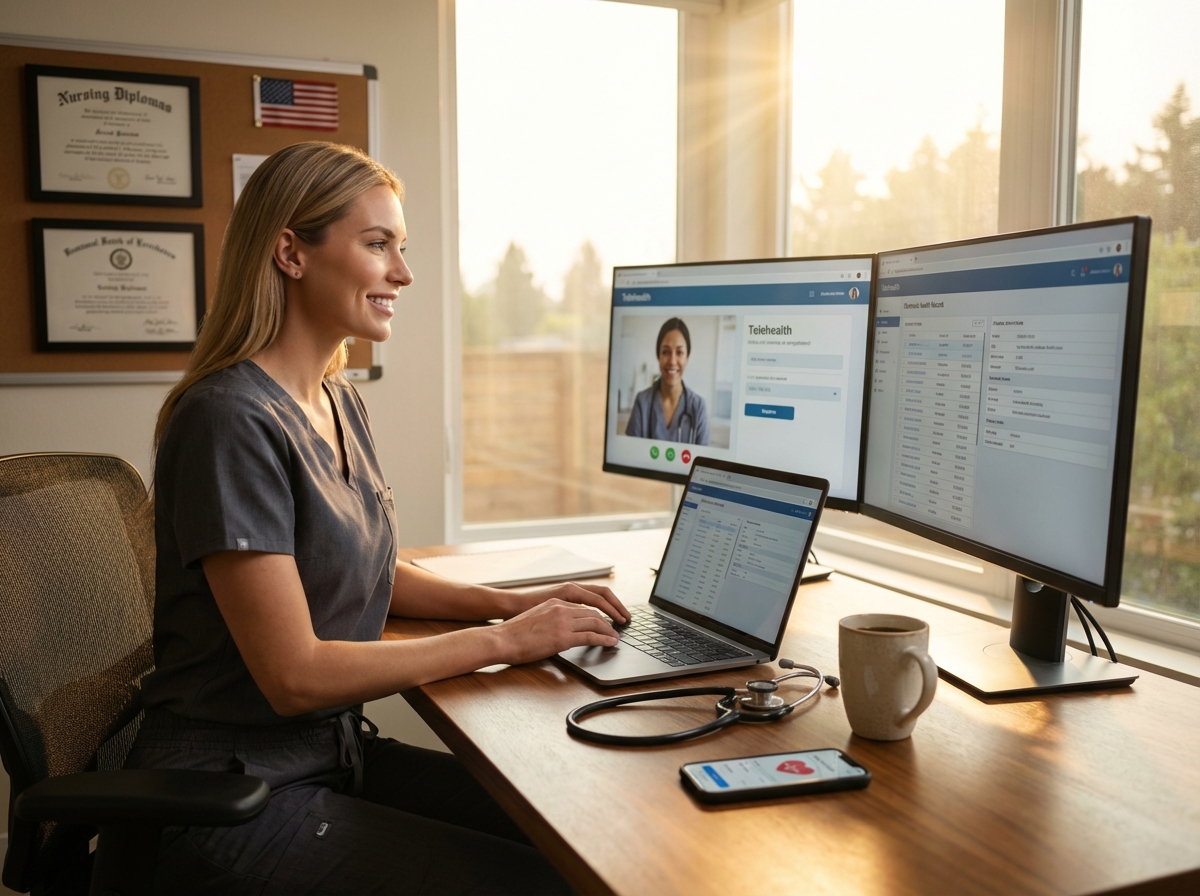
Remote nursing is expanding in 2026 as telehealth, case management, and digital-care platforms grow. This article maps top employers hiring remote RNs, LPNs, and advanced practice nurses and gives step-by-step guidance on choosing the right certification path, preparing for licensure and specialty exams, navigating renewal rules, and building a remote nursing career ladder in the United States.
Remote nursing market landscape and top employers hiring in 2026
The national nursing landscape in 2026 is defined by a significant gap between available talent and healthcare demand. Projections indicate that the total supply of nursing staff will only meet about 91.94 percent of the national requirement. This shortage is particularly visible among Licensed Practical Nurses, where the deficit reaches nearly 20 percent. Registered Nurses face a 10 percent shortage. These statistics explain why remote roles have transitioned from a luxury to a core recruitment strategy for major health organizations.
The shift toward virtual care is fueled by a 33 percent increase in executive focus on connected care programs. Payers are moving toward value-based care models that prioritize home-based primary care and chronic care management. Digital therapeutics and remote patient monitoring have become standard tools for managing patient populations. This evolution has created a diverse range of remote positions that go far beyond simple phone triage.
Common Remote Nursing Roles and Compensation
The variety of work-from-home roles has expanded to include specialized clinical and administrative functions. Salaries for these positions remain competitive with traditional bedside roles.
| Job Title | Typical Salary Range | Primary Responsibilities |
|---|---|---|
| Teletriage Nurse | $70,000 to $95,000 | Virtual assessment and patient routing |
| Remote Case Manager | $80,000 to $110,000 | Care transitions and readmission prevention |
| Utilization Review RN | $70,000 to $90,000 | Medical necessity and insurance policy review |
| Clinical Documentation Specialist | $70,000 to $115,000 | Coding accuracy and chart improvement |
| Informatics Nurse | $100,000 to $130,000 | Digital tool design and data analytics |
Top Employers Hiring Remote Nurses in 2026
Large insurance payers and national telehealth platforms dominate the hiring landscape. These organizations offer the most stability and comprehensive benefit packages.
UnitedHealth Group and Optum
This organization is a primary driver of remote nursing employment. They frequently recruit for nurse case managers and utilization review specialists. They prefer candidates with experience in Medicare Advantage and value-based care. Most roles require a BSN and at least two years of clinical experience.
CVS Health and Aetna
Hiring here focuses on population health and telephonic care management. They look for nurses to support disease management programs and specialty pharmacy services. Proficiency with integrated electronic medical records is a standard requirement for their remote teams.
Humana
Humana focuses heavily on the geriatric population. They hire advanced population health nurses and case managers for their Medicare programs. They often prioritize nurses who hold a Certified Case Manager credential.
Teladoc Health and Amwell
These are the leading telehealth platforms. They recruit for teletriage and telemedicine RN roles. Candidates must be comfortable with video conferencing tools and virtual assessment protocols. They often require nurses to hold licenses in multiple states or be eligible for the Nurse Licensure Compact.
Kaiser Permanente and Mayo Clinic
Integrated health systems have expanded their digital health divisions. They hire remote nurse navigators and virtual care educators. These roles often involve supporting patients through complex surgical pathways or chronic disease education via patient portals.
Labcorp and IQVIA
The clinical research sector offers unique opportunities for nurses in study coordination. These employers hire remote clinical research nurses to support decentralized trials. Responsibilities include managing eConsent procedures and monitoring patient data from remote devices.
Maven Clinic and Carbon Health
Startups in the virtual care space often focus on niche populations. Maven Clinic hires for maternal and family health coaching. Carbon Health recruits for remote care coordination in virtual-first primary care settings. These companies often look for nurses with a background in women’s health or pediatrics.
Essential Skills and Certifications
Hiring managers in 2026 look for specific technical and clinical competencies. Experience with platforms like Zoom for Healthcare or Doxy.me is often required. You should be familiar with remote patient monitoring devices and how to interpret the data they generate.
Preferred Certifications
Holding a specialty certification can significantly increase your competitiveness. The Certified Case Manager (CCM) remains the gold standard for many payer roles. Informatics nurses should pursue the RN-BC credential from the ANCC. For triage roles, certifications like the CCRN or CEN demonstrate the high-level clinical judgment needed for virtual assessments.
Finding Legitimate Remote Opportunities
The search for a remote role requires a targeted approach. LinkedIn and Indeed are the most common platforms for job listings. You can also use specialized boards like FlexJobs which vets listings for legitimacy.
Spotting Scams
Remote job fraud is a concern. Legitimate employers will never ask you to pay for equipment or training during the hiring process. Always verify a job posting on the official company career page. Check that the recruiter is using a corporate email domain rather than a public one. You can find more details on navigating this market in the Remote Nursing Jobs 2026 Guide.
Application and Negotiation Strategy
The market is competitive, with many candidates submitting over 50 applications before securing a role. Tailor your resume with keywords like “telehealth,” “virtual assessment,” and specific EMR names like Epic or Cerner. Highlight any experience you have with remote collaboration tools like Microsoft Teams or Slack.
When evaluating offers, prioritize employers based on their technology stack and financial stability. Large payers like UnitedHealth or CVS Health often provide better long-term security than early-stage startups. Beyond the base salary, negotiate for home office stipends to cover internet and equipment costs. Inquire about reimbursement for continuing education and whether the role offers shift differentials for night or weekend coverage. This is especially important as 2026 healthcare industry predictions suggest a continued rise in connected care roles.
Choosing the right nursing certification path for remote work
The current nursing shortage is hitting different sectors with varying intensity as we head into 2026. While the national supply of nurses meets about 92 percent of the total demand, the gap for Licensed Practical Nurses is much wider at 20 percent. Registered Nurses face a 10 percent shortage. These numbers mean that employers are becoming more flexible with where nurses work, but they remain strict about the credentials required for remote roles. Choosing a path requires balancing the time spent in school against the specific requirements of telehealth platforms and insurance payers.
The LPN and LVN Entry Route
Remote Role Access
Licensed Practical Nurses have fewer remote options than Registered Nurses, but the 20 percent shortage has opened doors in specific areas. LPNs often find work in HEDIS abstraction, which involves reviewing records for quality metrics. Beyond abstraction, insurance companies frequently hire LPNs for prior authorization tasks, reviewing medical records to ensure they meet payer policies. They also work in care coordination support, telephonic appointment scheduling, or clinical documentation. Some teletriage roles allow LPNs to gather initial data before handing the call to an RN.
Timeline and Certification
An LPN program usually takes 12 months to complete. You must pass the NCLEX-PN exam to get your license. In 2026, the NCLEX-PN emphasizes data collection and basic therapeutic care under supervision. The cost for these programs ranges from 5,000 to 15,000 dollars at community colleges. While this is the fastest way to start working, it is not the most future-proof for remote careers. Many large payers like UnitedHealth Group prefer RNs for their complex case management positions.
The Registered Nurse Foundation
ADN versus BSN
An Associate Degree in Nursing is the quickest path to becoming an RN, taking about two years. However, 2026 hiring trends show a strong preference for the Bachelor of Science in Nursing. Many remote job listings for companies like CVS Health or Humana explicitly state that a BSN is preferred. If you have an ADN, you can still find remote work in utilization review or basic teletriage, though you will likely need at least two years of bedside experience first. The NCLEX-RN, required for licensure, focuses heavily on the management of care, advanced assessment, and professional leadership—skills critical for autonomous remote roles.
RN to BSN Bridging
If you are already working as an ADN, an online RN to BSN program is a smart move. These programs often take 12 to 18 months. Many are competency-based, meaning you can move faster if you already know the material. This path is highly valued by remote hiring managers because it shows you can manage your time in a digital environment. The cost is often between 8,000 and 20,000 dollars. Many employers offer tuition reimbursement to help cover this expense.
Advanced Practice and Leadership Pathways
MSN and DNP for Remote Leadership
A Master of Science in Nursing or a Doctor of Nursing Practice is necessary for high-level remote roles. These degrees lead to positions in clinical informatics, nursing education, or senior case management. Informatics nurses often earn over 130,000 dollars annually in remote roles. They design the very telehealth systems other nurses use. A BSN to MSN program usually takes 18 to 36 months. It is a significant investment but offers the highest stability in the remote market.
APRN Telehealth Practice
Nurse Practitioners are in high demand for virtual primary care. While some areas show a surplus of NPs, the growth of digital therapeutics and home-based primary care keeps the remote market active. APRNs must navigate complex state laws. The APRN Compact is still limited in 2026, so you must verify practice authority in the state where the patient is located. This path allows for autonomous practice and tele-prescribing, which are the most advanced remote nursing duties available.
Pathways Comparison for Remote Work
| Pathway | Typical Remote Job | Time to Complete | Estimated Cost | Demand Level |
|---|---|---|---|---|
| LPN/LVN | HEDIS, Care Coordination | 1 year | $5k – $15k | Moderate |
| RN (ADN) | Utilization Review, Triage | 2 years | $10k – $25k | High |
| RN (BSN) | Case Management, Telehealth | 4 years (or 1-2 bridge) | $20k – $60k | Very High |
| APRN (MSN/DNP) | Virtual Provider, Informatics | 6-8 years | $40k – $100k+ | High (Specialty) |
Selecting Your Education Provider
Accreditation and Online Formats
When picking a school, ensure it is accredited by the CCNE or ACEN. This is non-negotiable for remote employers. Many nurses now choose competency-based programs like those offered by Western Governors University or similar state-run online initiatives. These allow you to finish your degree while working full-time. Remote hiring managers view these degrees favorably because they prove you are tech-savvy. You should mention your experience with online learning platforms in your resume to highlight your digital literacy.
Employer Support and Tuition
Before paying out of pocket, check if your current employer offers tuition assistance. Many health systems in 2026 use these benefits to keep staff from leaving for travel roles. Some will pay for your BSN or MSN in exchange for a commitment to stay for two years. This is a great way to build the bedside experience you need for a future remote role without taking on massive debt.
Presenting Your Credentials to Remote Hiring Managers
Resume Optimization
Remote hiring uses automated systems to screen candidates. You must list your degree and license clearly. If you have a multistate license through the Nurse Licensure Compact, put that at the top. It makes you three times more likely to get an interview because the company can use you in multiple states. Use keywords like telehealth, EMR proficiency, and virtual assessment. If you completed your degree online, emphasize the digital collaboration tools you used, such as Microsoft Teams or Zoom for Healthcare. This shows you are ready for the remote environment from day one.
For more details on the transition to virtual roles, you can view the Remote Nursing Jobs 2026: The Complete Guide to Leaving the Bedside. This resource provides deeper insights into salary expectations and the shift away from traditional hospital settings. Understanding the Telehealth Nurse Career Guide 2026 is also helpful for mapping out your specific clinical requirements before applying to top platforms.
Specialty certifications exam preparation and telehealth specific credentials
High Value Specialty Certifications for Remote Roles
Certified Case Manager (CCM)
The CCM is a top credential for remote nursing in 2026. It is widely recognized by insurance companies and large health systems. Eligibility requires an active RN or LPN license. You must have 12 to 24 months of full time experience in case management. The exam blueprint focuses on care coordination, reimbursement methods, and psychosocial intervention. Most nurses spend 60 to 90 days studying. Validated resources include the CCMC official study guide and their practice exams. The cost is approximately 300 to 500 dollars. You must renew every five years with 80 hours of continuing education.
Certified Utilization Review Credentials
Utilization review roles are common in remote work. Credentials like the Health Care Quality and Management (HCQM) certification show expertise in medical necessity. Eligibility usually involves an RN license and experience in quality review. The exam covers managed care, patient safety, and transitions of care. A 60 day study timeline is standard. Use the American Board of Quality Assurance and Utilization Review Physicians resources. Costs vary but often fall between 400 and 600 dollars. Maintenance requires biennial renewal with specific credits in quality improvement.
Telehealth and Virtual Care Certificates
The American Academy of Ambulatory Care Nursing (AAACN) offers recognized telehealth certificates. These modules cover the scope of practice and nursing standards in virtual environments. The American Telemedicine Association provides resources for vendor specific training. These certificates do not always require a separate exam. They focus on competency in virtual engagement. Most nurses complete these in 30 days. Costs are lower, often under 200 dollars. These are excellent for nurses with no prior remote experience.
Critical Care and Emergency Certifications
The CCRN and CEN are valuable for teletriage roles. Employers value the high level clinical judgment these certifications represent. Eligibility requires 1,750 to 2,000 hours of direct care in acute or emergency settings. The blueprints focus on multi system failure and life saving interventions. A 90 day study plan is recommended. Use the AACN or BCEN official question banks. Costs range from 230 to 400 dollars. Renewal happens every three years through clinical hours or continuing education.
Specialty Certifications in Oncology and Wound Care
The Oncology Certified Nurse (OCN) and Certified Wound Ostomy Nurse (CWON) are in demand for remote patient monitoring. Eligibility requires specific clinical hours in the specialty. Blueprints cover symptom management and treatment protocols. A 60 day study schedule is usually sufficient. Use the ONS or WOCNCB official review courses. Costs are around 300 to 400 dollars. These roles often pay more due to the specialized knowledge required.
Nurse Educator and Informatics
The Certified Nurse Educator (CNE) and RN-BC in Informatics are perfect for leadership. Informatics eligibility requires an RN license and 2,000 hours of informatics practice. The exam covers system design and data management. A 90 day study timeline is best. Use ANCC review materials. Costs are about 350 dollars. These credentials lead to roles in telehealth workflow design and staff training.
Sample Study Schedules
30 Day Intensive Plan
This plan is for nurses with significant experience in the specialty. Spend two hours daily on content review. Complete 50 practice questions every morning. Focus on the exam blueprint areas with the highest weight. Take a full practice exam on day 15 and day 28.
60 Day Standard Plan
This is the most common path. Spend one hour daily on a specific chapter of the study guide. Complete 25 questions daily. Use the first 30 days for content. Use the next 30 days for remediation and practice tests. This allows for a better work life balance.
90 Day Comprehensive Plan
This plan is best for nurses new to the specialty. Spend 30 minutes daily on reading. Complete 15 questions daily. Focus on one blueprint section every two weeks. This slow pace helps with long term retention of complex concepts.
Practical Telehealth Preparation
Documentation Best Practices
Remote documentation must be precise. You must record the technology used for the visit. You must document that the patient gave informed consent for a virtual encounter. Use structured data fields in the EMR to help with quality reporting. Always note the physical location of the patient for licensing compliance.
Virtual Physical Assessment Strategies
You must learn to assess patients through a screen. This involves coaching the patient to perform self exams. You might ask a patient to show their surgical site to the camera. You might guide them to check their own pulse. You must rely on data from remote patient monitoring devices. This requires understanding how to interpret data from home blood pressure cuffs and pulse oximeters.
HIPAA Compliant Technology Skills
Remote nurses must maintain a secure workspace. You need a private room with a door that locks. Your internet must be encrypted. You must be proficient in using two factor authentication. Familiarity with platforms like Zoom for Healthcare or Doxy.me is essential. Many employers provide specific training on their proprietary platforms during onboarding.
Stacking Certifications for Career Growth
Stacking credentials makes you a more competitive candidate. You can target higher paying leadership roles by combining specific certs. For example, an RN-BC in Informatics combined with a telehealth certificate and a CCM is a powerful stack. This shows you understand the technology. It shows you can manage complex cases. It proves you are competent in virtual care delivery. This combination is ideal for a Telehealth Nurse Career Guide 2026 path toward management. You can also combine a CEN with a telehealth certificate to lead a teletriage team. These stacks often result in a salary premium of 10 to 20 percent.
Licensing rules continuing education and compliance for remote practice
The legal landscape for remote nursing in 2026 is built on one primary rule. Nursing practice occurs where the patient is located, not where the nurse sits. If you are at your desk in New York and the patient is on a screen in Florida, you are practicing nursing in Florida. This simple fact dictates every licensing decision you make. It is the reason why the Nurse Licensure Compact (NLC) has become the most important tool for any nurse seeking a work from home role. Statistics from early 2026 show that having a multistate license increases your remote job opportunities by roughly three times. Most national telehealth platforms and large insurance payers now list a compact license as a non negotiable requirement for applicants.
Understanding the Nurse Licensure Compact in 2026
The NLC allows registered nurses and licensed practical nurses to hold one multistate license. This license grants the privilege to practice in any other state that has joined the compact. As of late 2025, the majority of US states participate in this system. Remote roles that rely heavily on the NLC include teletriage, virtual case management, and remote patient monitoring. Without a compact license, a nurse would need to apply for and maintain individual licenses in every state where their employer has patients. This is often too expensive and time consuming for most individuals to manage alone.
Multistate License Eligibility
To hold a compact license, your primary state of residence must be a member of the NLC. You must meet the uniform licensure requirements of your home state. This includes passing a criminal background check and the NCLEX. If you move your primary residence to a non compact state, your multistate license becomes a single state license. You would then need to apply for individual licenses in any other state where you wish to work. Many nurses find this transition difficult when moving for personal reasons while trying to keep a remote job.
The Status of the APRN Compact
Advanced practice nurses face a more complex situation. The APRN Compact has not seen the same level of universal adoption as the RN version. By December 2025, only a handful of states have fully implemented the multistate agreement for NPs and other advanced roles. This means most APRNs working remotely must still verify practice authority state by state. You must confirm if a state allows full practice authority or requires a collaborative agreement with a physician. This is especially critical for remote prescribing. Telehealth prescribing laws are strict. They often require the provider to hold a valid license and a state specific DEA registration in the state where the patient resides.
License Renewal and Continuing Education
Maintaining an active license while working remotely requires careful tracking of state board cycles. Most states operate on a biennial renewal schedule, but some require annual updates. The number of required continuing education (CE) hours varies significantly. You might find states that require 30 hours every two years, while others only ask for 10 hours annually. It is your responsibility to know these numbers for your home state and any other states where you hold individual licenses.
Mandatory CE Topics
State boards are increasingly specific about what topics you must study. Many states now mandate two or three hours of education on opioid awareness or controlled substance prescribing. Others require specific courses on child abuse reporting or human trafficking. In 2026, some states have added requirements for telehealth specific training. This covers the legal and ethical nuances of virtual care. Using an automated tracking tool or a digital folder to store your certificates is the best way to avoid a lapse in your license. Many remote employers now offer access to CE platforms as a benefit, which helps reduce the out of pocket cost for nurses.
Employer Compliance and Security Standards
Working from home introduces unique security risks that do not exist in a hospital. Employers must ensure that every remote nurse follows HIPAA and telehealth security best practices. You will likely be required to prove that you have a private, quiet workspace with a door that locks. Your internet connection must be secure and meet specific speed requirements. Most telehealth platforms in 2026 suggest a minimum of 50 Mbps for stable video encounters. You should never use public Wi-Fi for patient care. Employers often provide encrypted laptops and require two factor authentication for all logins.
Documentation and Informed Consent
Clinical documentation for remote visits must be precise. You need to record the technology used for the visit and the location of the patient. Obtaining and documenting informed consent for telehealth is a legal necessity. This includes explaining to the patient how the technology works and the potential risks to their privacy. If you are working in case management or utilization review, your documentation must clearly show how you applied medical necessity criteria to the patient’s specific situation.
Actionable Checklist for Remote Roles
Before you accept a remote nursing position, you should perform a thorough compliance check. This protects your license and ensures the employer has the right infrastructure in place. You can find more details on preparing for these roles in this Remote nursing jobs 2026 guide.
State Practice Requirements
Confirm which states the employer operates in. Ask if they require you to hold a compact license or if they will pay for additional individual state licenses. Verify if the state where the patient is located has specific rules for teletriage or remote assessment.
Credentialing and Privileging
Ask about the timeline for credentialing. This process can take anywhere from two to eight weeks. You will need to provide primary source verification for your education, licenses, and any specialty certifications.
Malpractice Insurance
Verify that the employer provides malpractice coverage that specifically includes telehealth. Some policies have geographic limitations. You need to know if you are covered when treating patients across state lines.
DEA and Prescribing
If your role involves prescribing, ask how the company handles DEA registrations. Some employers reimburse the costs for multiple state registrations. Others may have specific protocols for prescribing controlled substances via telehealth.
Licensure Support
Ask the hiring manager if the company provides a stipend for license renewals. Some organizations have dedicated departments to help nurses manage their multistate filings and CE tracking. This support is a major advantage for long term career stability in the remote sector.
Conclusion and next steps to secure a remote nursing role in 2026
The transition to a remote nursing career in 2026 requires a shift in how you present your clinical expertise. The healthcare market is currently facing a national nursing shortage of approximately 8 percent. This gap is even wider for Licensed Practical Nurses where the shortage rate is nearly 20 percent. While these numbers suggest high demand, the competition for work from home roles remains intense. Many qualified nurses submit dozens of applications before they receive a single interview invitation. Success in this environment depends on how well you align your existing skills with the digital requirements of modern telehealth employers.
Strategic Alignment of Skills and Roles
The most successful candidates in 2026 are those who treat their transition like a specialized clinical rotation. You must prove that your bedside experience translates to a virtual environment. Employers such as UnitedHealth, CVS Health, and Humana are looking for nurses who can manage patient populations without physical contact. This means your ability to document accurately and interpret remote data is more important than ever. If you have experience with specific electronic medical record systems like Epic or Cerner, you should highlight this. Many remote roles now require proficiency in remote patient monitoring tools and secure communication platforms.
Choosing the right certification path is the most effective way to stand out. A Certified Case Manager credential is often a baseline requirement for high paying roles at major insurance payers. If you prefer the fast paced nature of triage, certifications like CCRN or CEN demonstrate that you can make critical decisions under pressure. For those interested in the technical side of healthcare, the RN-BC in Informatics is becoming a gold standard. This certification shows you understand how to design and improve the digital workflows that remote nurses use every day.
Licensure and the Compact Advantage
Your nursing license is your most valuable asset, but its value changes depending on where you live. The Nurse Licensure Compact continues to be the primary factor in expanding job opportunities. Having a multistate license can triple the number of roles you are eligible for because it allows you to treat patients in dozens of participating states. If you do not live in a compact state, you may need to apply for individual licenses in high demand areas like California or New York. Always verify the rules of the state where the patient is located. This is the jurisdiction that typically governs your practice during a telehealth encounter.
Actionable Career Roadmap
To secure a role in the coming year, you need a structured plan. Breaking your goals into manageable timeframes prevents burnout and ensures steady progress toward your remote career.
The First 30 Days
Focus on your digital presence. Update your resume and LinkedIn profile with keywords that recruiters use to filter candidates. Include terms like teletriage, case management, and remote patient monitoring. List every telehealth platform or video conferencing tool you have used. Ensure your resume clearly states if you hold a multistate license. This is also the time to set up a dedicated, HIPAA compliant workspace in your home with high speed internet. Most employers require a minimum of 50 Mbps for video visits.
The 90 Day Window
Commit to a specific certification or advanced training program. Enroll in a prep course for the CCM or a telehealth specific certificate program from a recognized body like the AAACN. If you are a new graduate, focus on passing the NCLEX and gaining at least one year of clinical experience. Most remote employers still prefer two to three years of bedside work before they will consider you for a virtual role. Start applying to entry level remote positions such as HEDIS abstraction or seasonal care coordination to get your foot in the door.
The One Year Goal
Complete your BSN or a graduate degree if you want to move into leadership. Many large health systems like Kaiser Permanente or Mayo Clinic prefer BSN prepared nurses for their virtual care educator and navigator roles. If you are already an RN, look into accelerated online programs that offer tuition reimbursement through your current employer. By the end of the year, you should have at least one specialty certification that aligns with your desired remote niche. This long term investment future proofs your career as the industry moves toward more complex remote monitoring and digital therapeutics.
Final Considerations for 2026
The remote nursing market is stable and growing. Analysts expect this trend to continue through 2028 as value based care programs expand. However, you must remain vigilant about changing state board rules and employer policies. Check the official career pages of companies like Teladoc and Amwell regularly for new openings. For more detailed insights on salary ranges and role descriptions, you can review the Remote Nursing Jobs 2026 Guide. Stay persistent in your search and keep your clinical skills sharp. The transition from the bedside to the home office is a significant change, but it offers a sustainable path for long term professional growth.
Sources
- Remote Nursing Jobs 2026: The Complete Guide to Leaving the … — Remote nursing jobs pay between $60,000 and $150,000 depending on role and experience. Telehealth triage nurses average $70,000-$95,000, case …
- Nursing Shortage: 2026 US Statistics & Key Insights — At the national level, the projected supply of all nursing staff in 2026 will account for 91.94% of demand, leaving a nursing shortage rate of …
- Telehealth Nurse Career Guide 2026 | Salary, Jobs & How to Get … — Learn how to become a telehealth nurse in 2026. Explore job roles, RN requirements, average salaries, and career paths in virtual nursing.
- 2026 Travel Nursing Job Market Outlook | Prolink — Around the country, there are 4.3 million registered nurses (RNs) with active licenses. However, only 3.5 million are providing care to patients …
- 10 Healthcare Workforce Trends to Watch in 2026 – Syncx — This blog dives into 10 critical healthcare workforce trends set to define the sector in 2026 and moving forward. Click to learn more.
- The Future of Nurse Staffing: In-Demand Roles & Smart Hiring … — According to the U.S. Bureau of Labor Statistics, demand for registered nurses is projected to grow 9% by 2030, while advanced practice nurses are expected to …
- 5 Healthcare Staffing Predictions in 2026 | All Medical Personnel — From AI tools to workforce trends, discover five predictions shaping the future of healthcare jobs and staffing in 2026.
- 2026 Healthcare Industry Predictions: What Every Nurse Must Know — A significant 33% increase in connected care focus (up 15 points from 2025) signals enhanced roles in virtual care delivery and remote patient …
- CNO-Trends to Watch 2026 – HealthStream — The nursing shortage continues to be one of the most pressing challenges in healthcare, but in 2026, the issue will become more about specific talent gaps than …
Legal Disclaimers & Brand Notices
The content provided in this article is for informational and educational purposes only and does not constitute medical advice, professional nursing consultation, or a provider-patient relationship. The discussion of clinical protocols, virtual assessment strategies, and symptom management is intended to illustrate career pathways and does not replace professional medical judgment or formal clinical training.
All product names, logos, and brands mentioned in this article, including but not limited to Zoom for Healthcare, Doxy.me, Epic, Cerner, Microsoft Teams, and Slack, are the property of their respective owners. Use of these names, trademarks, and brands is for identification purposes only and does not imply endorsement, affiliation, or sponsorship.