This guide walks you through California nursing licensure from initial training to specialty certification and renewal. Learn which board to apply to, step-by-step application and NCLEX procedures, options for out-of-state or internationally educated nurses, exam-prep strategies, and how to advance your nursing career in California.
Which Nursing Path Is Right for You in California
Choosing to become a nurse in California is the first step. The next, and arguably most important, is deciding which nursing path to take. This initial choice determines your education, the scope of your future practice, and the specific license you will apply for. In California, the journey begins with a fundamental decision between becoming a Licensed Vocational Nurse (LVN) or a Registered Nurse (RN). Each path is governed by a different state board and sets you on a distinct career trajectory.
The fastest route to patient care is the Licensed Vocational Nurse path. Governed by the California Board of Vocational Nursing and Psychiatric Technicians (BVNPT), the LVN role is perfect for individuals eager to enter the workforce quickly. Educational programs are typically certificate or diploma-based and can be completed in 12 to 18 months. As an LVN, your practice focuses on providing direct, hands-on patient care under the supervision of an RN or physician. Your duties often include monitoring vital signs, administering basic medications, changing dressings, and assisting patients with daily activities. You’ll most commonly find LVNs working in skilled nursing facilities, long-term care centers, doctor’s offices, and home health settings. This path is a practical entry point into nursing that shapes your initial licensing steps, requiring you to pass the NCLEX-PN exam.
If you are seeking a broader scope of practice and more career autonomy, the Registered Nurse path is your destination. The California Board of Registered Nursing (BRN) oversees all RNs. The educational commitment is greater, but so are the opportunities.
- An Associate Degree in Nursing (ADN) is the most common entry-level path, typically taking two to three years at a community college.
- A Bachelor of Science in Nursing (BSN) is a four-year university degree that is increasingly preferred by employers, especially hospitals, and is essential for most leadership roles and graduate studies.
- For those who already hold a bachelor’s degree in another field, an Accelerated BSN (ABSN) program offers a faster route to an RN license, usually in 12 to 18 months. A Direct-Entry Master of Science in Nursing (MSN) is another option for career changers, combining RN licensure preparation with a master’s degree.
An RN’s scope of practice is significantly wider than an LVN’s. It involves critical thinking, comprehensive patient assessment, creating and implementing care plans, administering a wide array of medications, and providing complex patient education. RNs also supervise LVNs and other healthcare staff. This path culminates in taking the NCLEX-RN exam for licensure.
The RN license, particularly with a BSN, also serves as the foundation for advanced practice roles. These are graduate-level specializations, all regulated by the BRN, that require additional education and certification.
- Nurse Practitioners (NPs) act as primary or specialty care providers, diagnosing conditions and prescribing treatments.
- Clinical Nurse Specialists (CNSs) are experts in a specific area of care, improving outcomes for patient populations.
- Certified Nurse-Midwives (CNMs) provide comprehensive care to women before, during, and after childbirth.
- Certified Registered Nurse Anesthetists (CRNAs) administer anesthesia for surgical and procedural settings.
If you have any ambition to pursue one of these highly autonomous and specialized roles in the future, the RN path is a necessary starting point.
So, how do you choose? Your decision should balance personal ambition with practical realities.
Your Timeline
How quickly do you need or want to start working? If your goal is to enter the nursing field in under two years, the LVN path is the most direct. An ADN or ABSN program can get you licensed as an RN relatively quickly as well, but a traditional BSN is a four-year commitment.
Your Career Goals
Where do you see yourself in ten years? If you envision working in a critical care unit at a major hospital, pursuing management, or becoming an advanced practice nurse, starting with an RN program, ideally a BSN, is the most strategic move. If you are passionate about providing fundamental, comforting care in a stable environment like a long-term care facility, the LVN role can be incredibly fulfilling.
Your Budget
Vocational LVN programs and community college ADN programs are significantly more affordable than four-year university BSN programs. Consider your financial situation and the availability of financial aid for each option. Remember that while starting as an LVN is less expensive, many later invest in LVN-to-RN bridge programs to advance their careers.
Your initial choice sets the stage for your entire nursing career in California, from the school you attend to the licensing exam you take. While bridge programs offer flexibility to change paths later, making an informed decision now will save you time and resources as you move forward.
Education and Program Approval Requirements
Once you’ve decided whether the LVN or RN path is your goal, the next step is building the right educational foundation. Your journey to a California nursing license begins long before you fill out an application; it starts in the classroom. This phase is about meeting prerequisites, choosing a state-approved program, and understanding how that choice will shape your entire career.
Laying the Groundwork: Pre-Nursing Education
Before you can even apply to a nursing program, you need to meet some basic academic requirements. A high school diploma or a GED is the absolute minimum starting point. From there, nursing schools require a specific set of prerequisite college-level courses. While these can vary slightly between institutions, you should plan to complete courses in:
- Anatomy with a lab
- Physiology with a lab
- Microbiology with a lab
- Chemistry (often with a lab)
- English Composition
- Psychology or Sociology
- Communications or Public Speaking
These courses are not just hurdles to clear. They provide the essential scientific knowledge you will use every day as a nurse to understand disease processes, medication actions, and patient responses. Strong performance in these classes is critical for getting accepted into a competitive nursing program.
Choosing a State-Approved and Accredited Program
This is the most important decision you will make at this stage. To be eligible for a nursing license in California, you must graduate from a nursing program that is officially approved by the state’s governing board.
For Licensed Vocational Nurses (LVNs)
Your program must be approved by the California Board of Vocational Nursing and Psychiatric Technicians (BVNPT). The BVNPT maintains a list of all approved vocational nursing programs on its official website. Do not rely on other sources; always verify a program’s status directly with the board before enrolling.
For Registered Nurses (RNs)
Your program must be approved by the California Board of Registered Nursing (BRN). The BRN provides a searchable list of approved pre-licensure RN programs on its website. This is the only definitive source for confirming a program’s approval status. Graduating from an unapproved program will make you ineligible to take the NCLEX-RN and receive a California license.
Beyond state approval, RN programs also have programmatic accreditation. This is a separate layer of validation from national organizations that ensures the program meets high standards for quality and integrity. The three main accrediting bodies are:
- Accreditation Commission for Education in Nursing (ACEN)
- Commission on Collegiate Nursing Education (CCNE)
- National League for Nursing Commission for Nursing Education Accreditation (CNEA)
While accreditation may not be strictly required for initial licensure, it is crucial for your future. Graduating from an accredited program is often necessary to transfer credits, apply for federal financial aid, get hired at certain hospitals (especially Magnet-designated facilities), and gain admission to graduate nursing programs for advanced practice roles.
Making Strategic Choices: ADN vs. BSN and Bridging Options
As an aspiring RN, you’ll choose between an Associate Degree in Nursing (ADN) and a Bachelor of Science in Nursing (BSN). An ADN program is typically two years and is the fastest route to becoming an RN. A BSN is a four-year degree that provides a broader education, including topics like research, leadership, and public health. While both paths lead to the same RN license, a BSN is increasingly preferred by employers and is the standard requirement for advancing to graduate school for roles like Nurse Practitioner or for most specialty certifications.
If you are already an LVN or have an ADN, California offers excellent bridge programs. LVN-to-RN programs allow you to build on your existing knowledge to earn an associate’s degree. RN-to-BSN programs are designed for working nurses with an ADN to complete their bachelor’s degree, often through flexible online formats.
Preparing for the Practical Side
As you research programs, consider the practical aspects. Nursing school is a significant financial and time commitment. Look into financial aid, scholarships, and student loan options early. Also, inquire about clinical placements. Your program will arrange for you to get hands-on experience in hospitals and other healthcare settings. Understand how these placements are assigned and the time commitment required, as this will be a major part of your education.
Once you complete your program, the school will need to provide official documentation to the licensing board. This typically includes official transcripts sent directly from the registrar, a verification of program completion form, and confirmation of your graduation date. These documents are proof that you have met the educational requirements necessary to move on to the next step: applying for your license and registering for the NCLEX exam.
Applying for Licensure and Exam Registration
Once you’ve completed your nursing program, the next phase involves navigating the administrative steps to get your license. This process runs on two parallel tracks. You’ll submit an application for licensure to the California nursing board, and you’ll register to take the National Council Licensure Examination (NCLEX). Both must be completed successfully before you can officially call yourself an LVN or RN.
Your Application to the California Nursing Board
This is your formal request to the state for a license. It’s a detailed process where you prove you’ve met all the educational and safety requirements. Forgetting a step can cause significant delays, so it’s best to approach it like a checklist.
- Submit the Application to the Correct Board.
This is a critical first step. If you are pursuing a career as a Registered Nurse (RN), you will apply to the California Board of Registered Nursing (BRN). If you are becoming a Licensed Vocational Nurse (LVN), your application goes to the Board of Vocational Nursing and Psychiatric Technicians (BVNPT). Submitting to the wrong board will stop your application in its tracks. Most applications can now be completed online through the BreEZe system. - Pay the Application Fees.
Each application requires a non-refundable fee. For RN applicants seeking licensure by examination, the fee is currently $300. LVN fees are similar, but always confirm the exact amount on the BVNPT website. This fee covers the board’s cost of reviewing your file and determining your eligibility to take the NCLEX. - Request Official Transcripts.
Your nursing school must send your official transcripts directly to the board. The board will not accept transcripts that you send yourself, even if they are in a sealed envelope. Contact your school’s registrar’s office well in advance of graduation to make this request. Ensure the transcript shows your graduation date and the degree you earned. - Complete a Criminal Background Check.
All applicants must undergo a criminal background check through fingerprinting. If you are in California, you must use the Live Scan service. The board provides the specific Live Scan form you need to take to a service location. If you are out of state, you will need to use the traditional hard card fingerprint method. This step is mandatory, and your license will not be issued until your background check is cleared by both the California Department of Justice (DOJ) and the FBI.
Registering for and Taking the NCLEX
While the board processes your application, you can move forward with registering for the exam. The board and the testing service, Pearson VUE, work together to get you scheduled.
The NCLEX Registration Workflow
First, you must create an account and register for the NCLEX with Pearson VUE. This involves a separate fee paid directly to them. After you register, Pearson VUE waits for the California board to give them the green light. Once the BRN or BVNPT has reviewed your application and confirmed you are eligible, they notify Pearson VUE. At that point, Pearson VUE will email you an Authorization to Test (ATT). Your ATT is your ticket to schedule the exam and is valid for a specific window of time, usually 90 days. Do not let it expire. Schedule your test as soon as you receive it to get your preferred date and location.
On test day, arrive early with your valid, government-issued ID. The name on your ID must exactly match the name you used to register. After you complete the exam, you will not receive an immediate score. Pearson VUE offers unofficial “quick results” after 48 hours for a small fee, but your official results will come from the nursing board. Once the board receives your passing score and your background check is clear, they will issue your official nursing license number, which you can look up on their website.
Timelines, Permits, and Common Pitfalls
Processing times can vary significantly. While the boards aim for efficiency, it’s wise to plan for several weeks or even months, especially during peak graduation seasons. Always check the board’s website for the most current processing time estimates.
A note on temporary permits: Unlike some states, California does not issue temporary licenses or interim permits for any applicants, including new graduates or those applying by endorsement. You cannot practice nursing in any capacity until your full, permanent license number is officially issued and verifiable on the board’s website. This is a critical point to consider for job-start-date planning.
To keep your application moving smoothly, avoid these common mistakes.
- Incomplete Transcripts. Ensure your school sends the final, official transcript that clearly states your graduation date and degree conferred.
- Missed Fingerprinting. Don’t delay the Live Scan process. Your application is considered incomplete without it.
- Mismatched Names. The name on your application, your ID, and your Pearson VUE registration must be identical. Any variation can cause delays or prevent you from testing.
Licensing by Endorsement and Internationally Educated Nurses
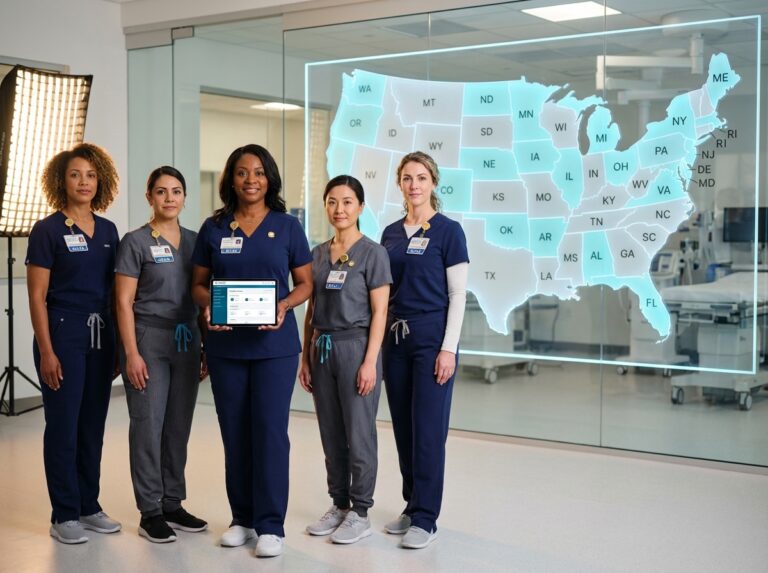
If you’re already a licensed RN or LVN in another U.S. state or territory, moving your career to California is streamlined through a process called licensure by endorsement. This pathway is for nurses who have already passed the NCLEX and hold an active license in good standing. It bypasses the need to retake the exam, focusing instead on verifying your existing credentials and qualifications.
The process for endorsement is generally faster than applying by examination, but it still requires meticulous attention to detail. You will need to submit a complete application package to either the Board of Registered Nursing (BRN) for RNs or the Board of Vocational Nursing and Psychiatric Technicians (BVNPT) for LVNs. The core components of this package typically include:
- Verification of Licensure. You must provide proof of your initial and current nursing licenses. Most states use the Nursys platform for electronic verification, which you can request be sent directly to the California board. If your state doesn’t use Nursys, you’ll need to contact your original board of nursing to have a paper verification form completed and mailed.
- Employment History. You will be asked to detail your nursing work experience, usually covering at least the past two years.
- Fingerprinting and Background Check. Just like new applicants, you must complete the fingerprinting requirement using either the Live Scan service if you are in California or by submitting traditional hard cards if you are out of state.
- Official Transcripts. While you’ve already been licensed, California may still require official transcripts from your nursing program to be sent directly from the institution to the board to ensure your education meets state standards.
The primary difference for endorsement applicants is the absence of the NCLEX registration step. Your focus is purely on document submission and background clearance. Processing times can range from a few weeks to several months, so it is critical to check the current timelines on the BRN’s endorsement page and start the process well before you plan to begin working.
For nurses educated outside of the United States, the journey to California licensure is more complex and requires careful planning. This path almost always begins with a thorough evaluation of your educational credentials. You must have your foreign nursing transcripts reviewed by an independent credentialing agency approved by the California boards. This isn’t just a simple translation; it’s a detailed, course-by-course evaluation that compares your curriculum, clinical hours, and theoretical instruction against California’s stringent educational requirements.
If your nursing program was not taught in English, you will also likely need to pass an English proficiency exam, such as the TOEFL or IELTS, with a qualifying score. Once your educational evaluation is complete, you will submit it along with your application for licensure by examination. The board will review your entire file to determine if you are eligible to sit for the NCLEX. If deficiencies are found, you may be required to complete specific remedial courses before you can proceed.
Parallel to the licensure process is the immigration component. To obtain an occupational visa or green card to work as a nurse in the U.S., you will need a VisaScreen Certificate, which is typically issued by CGFNS International, Inc. This certificate verifies that your education, licensure, and English proficiency meet the requirements for U.S. immigration. While the VisaScreen process uses many of the same documents as your state licensure application, it is a separate and distinct requirement for federal immigration purposes. You can receive your California nursing license without a VisaScreen, but you cannot legally work without the proper visa, which requires the VisaScreen.
Practical tips for internationally educated nurses:
- Timelines. Start early. The entire process, from credential evaluation to receiving an Authorization to Test (ATT) for the NCLEX, can easily take over a year.
- Document Management. Use professional, certified translation services for all documents not in English. Ensure your name is spelled identically across all transcripts, licenses, and applications to avoid delays.
- Stay Current. Rules and required forms change. Always download the most recent application packet directly from the BRN or BVNPT website before you begin. This is your single most reliable source of information.
Specialty Certification and Career Ladders in California Nursing
Earning your initial LVN or RN license in California is a huge accomplishment, but it’s often just the beginning of your professional journey. The nursing field offers incredible opportunities for growth, allowing you to specialize, take on more responsibility, and significantly increase your earning potential. Let’s explore the pathways available to you after you have that initial license in hand.
National Specialty Certifications
Once you gain experience as an RN, you can validate your expertise in a specific area with a national specialty certification. This is different from your state license. Your California RN license gives you the legal authority to practice, while a specialty certification is a national credential that proves you have advanced knowledge in a particular field. Employers in California highly value these certifications, often offering pay differentials or clinical ladder promotions to certified nurses.
Examples include:
- CCRN (Critical Care Registered Nurse) from the American Association of Critical-Care Nurses (AACN). Eligibility typically requires a specific number of clinical hours in a critical care setting.
- CNOR (Certified Perioperative Nurse) for operating room nurses, offered by the Competency and Credentialing Institute (CCI).
- CPN (Certified Pediatric Nurse) from the Pediatric Nursing Certification Board (PNCB).
To get certified, you’ll need an active, unencumbered RN license, a certain number of practice hours in your specialty, and you must pass a rigorous national exam. These certifications complement your state license by demonstrating a higher level of competency that is recognized across the country.
Advanced Practice and Academic Progression
For those looking to move into roles with greater autonomy and a broader scope of practice, pursuing an advanced degree is the next step. This usually means earning a Bachelor of Science in Nursing (BSN) if you have an ADN, followed by a graduate degree.
Career Ladder Pathways:
- LVN to RN to NP: Many LVNs bridge to an ADN or BSN program to become an RN. After gaining a few years of experience, you could enter a Master of Science in Nursing (MSN) or Doctor of Nursing Practice (DNP) program to become a Nurse Practitioner (NP). This entire path could take anywhere from five to eight years, depending on whether you study full-time or part-time.
- RN to BSN to DNP: An RN with an ADN can complete an RN-to-BSN program in about 12-24 months. From there, a DNP program can prepare you for leadership, education, or advanced practice roles. This path is ideal for nurses aiming for executive positions or faculty roles in universities.
Advanced Practice Registered Nurse (APRN) Roles in California:
All APRN roles require at least an MSN, national certification, and recognition by the California Board of Registered Nursing (BRN). The primary APRN categories are:
- Nurse Practitioner (NP): NPs provide primary and specialty care. You’ll choose a population focus like Family (FNP), Adult-Gerontology (AGNP), or Psychiatric-Mental Health (PMHNP). You must pass a national certification exam from an organization like the American Nurses Credentialing Center (ANCC) or the American Academy of Nurse Practitioners (AANP).
- Clinical Nurse Specialist (CNS): A CNS is an expert in a specific area of nursing care who often works in education, research, and consulting within a healthcare system.
- Certified Nurse-Midwife (CNM): CNMs provide care to women, including gynecological exams, family planning services, and labor and delivery.
- Certified Registered Nurse Anesthetist (CRNA): CRNAs administer anesthesia and are the sole anesthesia providers in many rural hospitals. Certification is managed by the National Board of Certification and Recertification for Nurse Anesthetists (NBCRNA).
California-Specific APRN Requirements
In California, APRNs function under the authority of the BRN. After you obtain your national certification, you must apply to the BRN for state certification in your specialty. For NPs wanting to prescribe medication, you must apply for a furnishing number, which gives you the authority to “furnish” or prescribe drugs. This involves completing an advanced pharmacology course. It is critical to always verify your current scope of practice directly with the California Board of Registered Nursing, as regulations can change. For instance, as of January 1, 2025, NPs who provide primary care to a significant population of patients over 65 must complete specific continuing education in gerontology.
Funding Your Advancement and Preparing for Exams
Advancing your education is a significant investment. Many California hospitals offer tuition assistance programs for employees pursuing BSN or graduate degrees. You can also explore federal student loans, private loans, and nursing-specific scholarships. The Johnson & Johnson Nursing and the American Association of Colleges of Nursing websites are great places to search for financial aid opportunities.
For exam preparation, whether for the NCLEX or an advanced certification exam, a structured study plan is key. Use a mix of resources like review courses, question banks (like UWorld or Kaplan), and study guides from the certifying body. A typical study plan involves dedicating 10-15 hours per week for at least two to three months before the exam, focusing on weak areas identified through practice tests.
Frequently Asked Questions about California Nursing Licensure
Navigating the licensing process in California can feel complex, but getting answers to the most common questions can make the journey much smoother. Here is a list of frequently asked questions to help you understand the key steps and requirements. Please note that requirements can change, and you should always confirm details directly with the appropriate licensing board.
Which board do I apply to for an LVN versus an RN license?
It depends on the license you are seeking. For Licensed Vocational Nurses (LVNs), you will apply to the California Board of Vocational Nursing and Psychiatric Technicians (BVNPT). For Registered Nurses (RNs), including all advanced practice roles like Nurse Practitioners (NPs), you will apply to the California Board of Registered Nursing (BRN). Each board has its own application, fees, and specific requirements.
What documents do I need to be eligible for the NCLEX?
To get your Authorization to Test (ATT) for the NCLEX, you must first submit a completed application for licensure by examination to the correct board (BRN for the NCLEX-RN, BVNPT for the NCLEX-PN). Key documents include the official application form, the required fee, and official transcripts sent directly from your nursing program to the board. You must also complete the mandatory fingerprinting and criminal background check. Your nursing program must meet all California educational standards. For a detailed checklist, visit the BRN’s Licensure by Examination page.
How long does the fingerprint and background check process take?
Processing times can vary significantly. After you submit your fingerprints via Live Scan (for California residents) or on a hard card (for out-of-state applicants), the California Department of Justice (DOJ) and the FBI conduct the background check. This can take anywhere from a few weeks to several months, especially if there is a potential conviction to review. It is one of the most common delays in the application process, so it’s wise to complete this step as early as possible. Always check the board websites for the most current processing time estimates.
Can I work as a nurse while my California license application is pending?
No. California does not have a “graduate nurse” status or any other provision that allows you to practice nursing while your application is being processed or while you are waiting to take the NCLEX. You must have an official, active license number issued by the BRN or BVNPT before you can engage in any nursing practice in the state. Working without a license can result in denial of your application and other penalties.
How do I transfer my nursing license from another state to California?
The process is called Licensure by Endorsement. You must hold a current, active, and unencumbered nursing license in another U.S. state or territory and have passed the NCLEX or a recognized predecessor exam (SBTPE). The application requires submitting proof of your education, verification of your existing license (usually done through the Nursys system), and completing the fingerprinting and background check. For complete instructions, see the BRN’s Licensure by Endorsement page.
Do internationally educated nurses have extra requirements?
Yes. Nurses educated outside the United States must prove their education is equivalent to California’s standards. This typically involves a course-by-course evaluation of your academic transcripts by a board-approved credentialing agency. If your nursing education was not conducted primarily in English, you will likely need to pass an English proficiency exam like the TOEFL. After meeting these requirements, you will still need to apply for licensure by examination and pass the NCLEX.
What are the license renewal and continuing education (CE) requirements?
Both RN and LVN licenses in California must be renewed every two years. To maintain an active license, you must complete 30 contact hours of board-approved continuing education during each renewal cycle. There are also specific one-time requirements, such as a one-hour course on implicit bias for all RNs, which must be completed within the first two years of licensure. Advanced practice nurses may have additional CE requirements. For example, as of January 1, 2025, certain NPs must complete hours in gerontology. Always check the BRN’s renewal page for the most up-to-date CE mandates.
How can I check my license status online?
Both the BRN and BVNPT offer online license verification portals that are available to the public. You can search for a license using a nurse’s name or license number. This tool is used by employers to verify credentials and allows you to confirm when your license has been officially issued or renewed. The BRN’s search portal is a primary source for verification.
What should I do if I have a criminal record or past disciplinary action?
You must disclose any and all convictions or disciplinary actions on your application, even if they were minor, occurred long ago, or were expunged. Failure to disclose is considered falsification of an application and is grounds for denial. The board evaluates each case individually, considering the nature of the offense, evidence of rehabilitation, and potential risk to public safety. You should be prepared to provide all related court documents and a detailed written explanation of the circumstances. The board websites provide guidance on how to properly report this information.
Final Takeaways and Next Steps
You’ve absorbed a lot of information, and now it’s time to turn that knowledge into a concrete plan. The path to becoming a licensed nurse in California is a marathon, not a sprint, but breaking it down into manageable steps makes it achievable. Here is a practical guide to what you can do right now and over the next few months to move your career forward.
Your Immediate Action Plan
Focus on these four tasks first. Completing them will build momentum and set a solid foundation for your application.
- Choose Your Program. Your first major decision is selecting a nursing program. The only valid options are those approved by the California Board of Registered Nursing (BRN) for RNs or the Board of Vocational Nursing and Psychiatric Technicians (BVNPT) for LVNs. Visit their websites to find official lists of approved schools. Consider factors like program length, cost, location, and NCLEX pass rates.
- Build Your Document Checklist. Get organized from day one. Create a physical or digital folder for all your application materials. Your checklist should include government-issued photo ID, social security information, and a plan for requesting official transcripts from your educational institutions. Having everything in one place prevents last-minute scrambling.
- Schedule Your Live Scan Fingerprinting. This is a non-negotiable step for the mandatory background check, and it can sometimes have a waiting period. Don’t delay. Download the correct Live Scan form from the BRN or BVNPT website and find an authorized location to get your fingerprints submitted electronically. This process runs parallel to your application, so starting it early is smart.
- Register for the NCLEX. This is a two-part process. First, you submit your application for licensure to the appropriate California board (BRN or BVNPT). Once the board determines you are eligible, they will notify Pearson VUE. You will then receive an Authorization to Test (ATT) email, which allows you to register and schedule your exam date. Pay close attention to the expiration date on your ATT.
Planning for the Medium Term
Once your initial application is underway, you can start mapping out your future. For nurses already licensed elsewhere, the focus will be on endorsement. This involves providing verification of your existing license and meeting any California-specific requirements. If you are an internationally educated nurse, your path will include a credentials evaluation from an approved agency to ensure your education meets California standards. For everyone, this is the time to think about your career ladder. Do you envision moving from an LVN to an RN? Or perhaps from an RN with an ADN to a BSN? Start researching bridge programs and specialty certifications that align with your long-term goals in areas like critical care (CCRN) or pediatrics (CPN).
A General Timeline from Start to Finish
While every journey is unique, here are some general timeframes for a candidate starting from scratch. An LVN program typically takes 12 to 18 months to complete. For an RN, an Associate Degree in Nursing (ADN) usually takes about two years, while a Bachelor of Science in Nursing (BSN) is a four-year commitment. After graduation, you should plan for another two to four months for application processing, receiving your ATT, and sitting for the NCLEX. Always check the California Board of Registered Nursing website for the most current processing times, as they can fluctuate.
Resources for Ongoing Support
You are not alone on this journey. Your primary resources will always be the official board websites. Bookmark them and check them often for updates on fees, continuing education rules, and application procedures. For exam preparation, numerous NCLEX prep providers offer courses, books, and question banks to help you succeed. Finally, consider joining a professional organization like the California Nurses Association. These groups offer networking opportunities, advocacy, and continuing education resources that will be valuable throughout your career.
Your path to becoming a nurse in California requires diligence and attention to detail. Stay persistent, even when the paperwork seems overwhelming. Keep all your documents, license numbers, and renewal dates in a secure and organized place. This profession is challenging but incredibly rewarding. By taking these deliberate steps, you are building the foundation for a long and successful career dedicated to caring for others.
Sources
- California Board of Registered Nursing — The primary source for all RN and APRN regulations, application forms, and policy updates, including new continuing education requirements.
- California Nurses CE Requirements, Accreditations & Approvals — An overview of the 30-hour continuing education requirement for RNs, LVNs, and APRNs, including details on the implicit bias training mandate.
- Registered Nurse Requirements By State | NurseJournal.org — A general guide to RN licensure, outlining the common requirements of an associate degree and passing the NCLEX-RN.
- California RN Licensing Guide on Vivian Health — A third-party guide summarizing the application process and educational requirements for obtaining a California nursing license.
- Licensure by Examination – California Board of Registered Nursing — Official BRN page detailing the requirements for new graduates applying for their initial RN license via the NCLEX exam.
- License/Certificate Renewal – California Board of Registered Nursing — The official source for RN license renewal procedures and the 30-hour continuing education mandate.
- Licensure by Endorsement – California Board of Registered Nursing — The official BRN page outlining the process for nurses already licensed in another state to obtain a California RN license.
- Steps to Become a CA RN – California Board of Registered Nursing — A high-level overview from the BRN on the educational pathway to becoming a Registered Nurse in California.
- California RN License 2025 Requirements … – YouTube — A video short discussing key requirements for nurses planning to work in California.