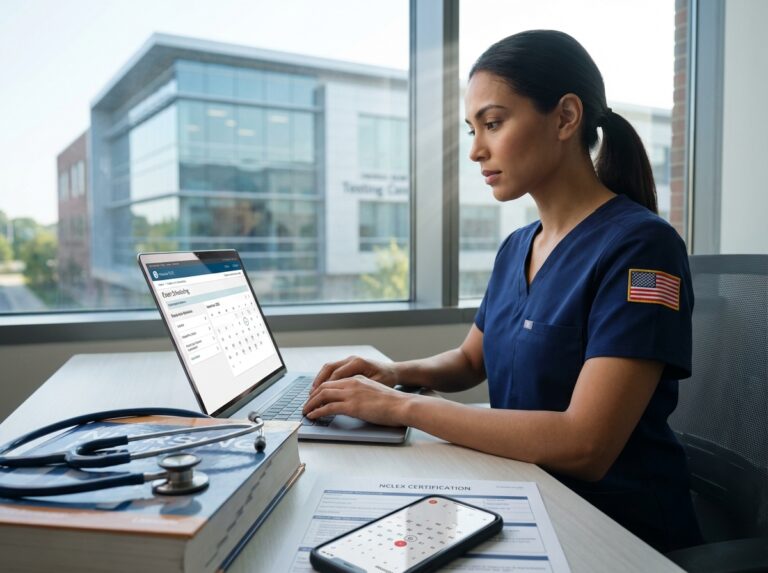
This 8-week NCLEX study plan helps U.S. nursing graduates balance UWorld question practice, Kaplan content review, and focused content study while aligning with licensing pathways for LPN/LVN, RN, and specialty certification goals. Followable weekly goals, daily hour targets, and licensing reminders help you maximize clinical judgment skills, pharmacology mastery, and test readiness to pass the NCLEX and advance your nursing career.
Setting goals and assessing your starting point
Embarking on an 8-week NCLEX study plan without first understanding your baseline is like starting a road trip without checking your fuel gauge or looking at a map. You might make progress, but you risk running out of steam in the wrong place. A baseline assessment is essential because it transforms your study plan from a generic template into a personalized, efficient roadmap. It reveals your specific content gaps and skill deficits, allowing you to allocate your limited time to the areas that will yield the highest return on test day. This initial diagnostic step prevents wasted effort on subjects you’ve already mastered and directs your focus squarely on your weaknesses.
Your first step is to complete two different types of diagnostics to get a full picture of your readiness. One measures your ability to apply knowledge in NCLEX-style questions, and the other assesses your core content foundation.
- UWorld Diagnostic.
The best option is a dedicated UWorld self-assessment exam. If you don’t have one available, create a 75 to 100-question test in tutor mode. Make sure it includes all subjects and systems. The goal here isn’t to score high; it’s to gather data. Tutor mode provides immediate feedback and rationales, which helps you understand your thought process on questions you miss. Pay close attention to the performance analytics, which will break down your results by topic and difficulty. - Kaplan Diagnostic.
Next, take a Kaplan content pretest or a topic-specific assessment. Kaplan’s strength lies in its structured content review. This diagnostic will highlight gaps in your foundational knowledge, such as pharmacology principles or developmental milestones, which are often the root cause of incorrect answers on application-based questions.
Once you have your results, you need to translate them into an action plan. Map your performance from both UWorld and Kaplan to the official NCSBN NCLEX Test Plan categories. Your score reports should align with these client needs categories, making this process straightforward. Look at your percentages in each of the four main areas and their subcategories.
- Safe and Effective Care Environment
- Management of Care
- Safety and Infection Control
- Health Promotion and Maintenance
- Psychosocial Integrity
- Physiological Integrity
- Basic Care and Comfort
- Pharmacological and Parenteral Therapies
- Reduction of Risk Potential
- Physiological Adaptation
From this analysis, identify your three lowest-scoring subcategories. These are your priority weaknesses. For the first two to three weeks of your plan, you will dedicate extra time and effort to mastering the content and question types within these specific areas.
With your weaknesses identified, it’s time to set clear, measurable goals. Vague targets like “study more” are not effective.
Weekly Question Completion.
Start with a manageable goal of 50–80 questions per day for the first two weeks, then ramp up to 80–150 questions on your main study days. This volume builds stamina and exposes you to a wide range of content.
Target Accuracy Percentages.
In the beginning, aim for over 60% correct on untimed, tutor-mode blocks where the focus is learning. For timed blocks, a starting goal of 55% is realistic. As you move into the final weeks, you should be consistently scoring above 65-70% on timed blocks.
NCLEX Readiness Score.
Your ultimate goal is to hit a readiness benchmark that strongly correlates with passing. For UWorld, achieving a percentile rank of 59th or higher on a self-assessment exam gives you a “High” or “Very High” probability of passing. For Kaplan, many successful test-takers aim for 65% or higher on their final readiness exam.
Finally, your specific career path influences your study priorities.
- An LPN/LVN to RN candidate should focus heavily on the expanded scope of practice, particularly in areas like Management of Care and complex Physiological Adaptation.
- A new graduate from an ADN or BSN program should ensure they are proficient in the Next Generation NCLEX clinical judgment items, which are integrated throughout the exam.
- If your long-term goal is specialty certification, your NCLEX prep builds the foundation. While you’ll focus on the generalist knowledge for the NCLEX now, you can start noting areas of interest for future specialization.
Before you finalize your calendar, check your state board of nursing’s website for licensing application timelines. Your Authorization to Test (ATT) is a critical document you will receive once you are deemed eligible, and it is only valid for a specific period. Knowing this window is critical for scheduling your exam date and ensuring your 8-week plan concludes at the right time.
8 Week Study Calendar with daily targets
With your baseline assessment complete and your priority areas identified, it’s time to translate that knowledge into a structured, daily plan. This eight-week calendar is a roadmap, not a rigid set of rules. Life happens, so be prepared to adapt. The goal is consistent, focused effort, not perfection.
Week 1: Establish Baseline and Build Foundations
Goal:
Solidify fundamental nursing concepts and confirm your weak areas through targeted practice. This week is about building a strong base, not speed.
Daily Hours: 4–6 hours
Qbank Goal: 50–80 questions/day
Your daily schedule should look something like this:
- Morning (1–2 hours): Dive into Kaplan’s content library, focusing on the absolute essentials. Review modules on Safety and Infection Control, Basic Care and Comfort, and foundational Pharmacology. These topics are woven into almost every NCLEX question.
- Mid-day (2–3 hours): Open UWorld and complete your daily question goal in tutor mode. This allows you to see rationales immediately. Read every single one, even for questions you answered correctly. Start creating digital or physical flashcards for medications, lab values, and procedures you don’t know cold.
- Evening (1 hour): Wind down with low-intensity drills. Complete 15–20 dosage calculation problems and review your new flashcards.
At the end of the week, look at your UWorld performance report. Do the analytics confirm the weaknesses you identified in your initial diagnostic? If so, you know where to aim your efforts next week.
Week 2: Build Core Knowledge and Daily Habit
Goal:
Develop a sustainable daily study routine while beginning to tackle your primary weakness, as identified by your diagnostics.
Daily Hours: 4–7 hours
Qbank Goal: 60–90 questions/day
Now you start integrating timed practice to build stamina:
- Morning (1–2 hours): Use Kaplan to review content related to your number one weakness. For example, if it’s Cardiovascular, watch the video lectures on cardiac disorders and pharmacology.
- Mid-day (2–3 hours): Complete your UWorld questions for the day. Start with a small, 25-question timed block to get used to the pressure, then finish the rest in tutor mode. Continue to review all rationales and make flashcards.
- Evening (1 hour): Do a focused review of pharmacology related to the day’s system. If you studied cardiac, review antihypertensives, antiarrhythmics, and diuretics.
To keep things fresh and reinforce learning, cycle through your subjects. Spend 2-3 days focused on one weakness (e.g., Cardiac), then switch to your second weakness (e.g., Pediatrics) for the next couple of days.
Weeks 3 to 6: Ramp Up Intensity and Integrate Resources
Goal:
Significantly increase question volume to master pattern recognition and integrate Kaplan’s targeted resources to fill content gaps.
Daily Hours: 5–8 hours
Qbank Goal: 80–150 questions/day
This is the core of your study plan. Your days will be demanding but productive:
- Morning (1.5–2 hours): Watch a Kaplan video lecture series on a high-yield topic. Dedicate specific weeks to areas like Maternity, Mental Health, or complex Med-Surg topics like Respiratory and Endocrine.
- Mid-day (3–4 hours): This is your prime Qbank time. Complete two 75-question timed blocks in UWorld. The review process is critical here. Don’t just see what you got wrong; understand why. Was it a knowledge gap, a misread question, or a test-taking error? Log your mistakes.
- Evening (1–1.5 hours): Use the Kaplan Qbank to take a short, 20-30 question topic test on the same subject you covered in the morning. This provides a different perspective and helps solidify the information. Finish by reviewing flashcards.
At the end of Week 4, take your first full-length practice exam. Use a Kaplan CAT or create a 150-question timed test in UWorld. This will give you a crucial progress report and help you fine-tune your plan for the next two weeks.
Week 7: Full-Length Practice and Focused Remediation
Goal:
Simulate the NCLEX experience to build mental endurance and use detailed performance feedback for a final, targeted review. Quality over quantity is the rule for practice exams; taking too many can cause burnout.
Daily Hours: 6–8 hours, with a rest day
Qbank Goal: Two full assessments plus 75–100 questions/day on off-days
This week is all about assessment and refinement:
- Day 1: Take the UWorld Self-Assessment exam. Treat it like the real thing: no interruptions, timed breaks, and quiet environment.
- Day 2: Dedicate the entire day to reviewing the self-assessment. Read every rationale. This is your last major diagnostic tool.
- Days 3-4: Zero in on any remaining problem areas revealed by the assessment. If you’re still struggling with prioritization, do 20-30 NGN-style case studies on UWorld each day.
- Day 5: Take a Kaplan full-length proctored practice test to experience a different question style and build more stamina.
- Day 6: Review the Kaplan exam. Avoid taking any full-length exams within the last five days of your test date to prevent fatigue.
- Day 7: Rest. Your brain needs to consolidate all this information. No questions. Light flashcard review is okay if you feel you must do something.
Week 8: Taper, Polish, and Prepare
Goal:
Reduce study load to prevent burnout, reinforce high-yield facts, and handle final test-day logistics.
Daily Hours: 2–4 hours
Qbank Goal: 50–75 questions/day (reviewing old questions only)
You’ve done the heavy lifting. Now it’s about staying sharp:
- Daily Tasks: Spend your time reviewing your handwritten notes, pharmacology charts, and lab value sheets. Go back through your UWorld Qbank and re-read the rationales for questions you previously flagged or got wrong. Do not take any new timed exams.
- Two Days Before: Do a dry run to the testing center to check traffic and parking. Pack your bag with your two forms of ID and Authorization to Test (ATT) letter.
- The Day Before: Do not study. Seriously. Watch a movie, go for a walk, eat a healthy meal, and get to bed early. Your performance now depends more on being rested than on cramming one more fact.
Contingency Plans
If your diagnostics showed major deficits:
Don’t stick to a plan that isn’t working. Extend the intensive “Weeks 3-6” phase by another week or two. Lower your daily question count to 50-75 and increase your dedicated content review time. You must understand the “why” before you can master the “how.”
If you’re studying part-time or around shifts:
Many students must balance NCLEX prep with work and family. Your plan must be realistic to be sustainable. Consistency beats cramming. On days you work, aim for a focused 3-4 hours, perhaps split into a session before and after your shift. For night shift workers, a common strategy is to study for 2-3 hours immediately after your shift, before you go to sleep. Use your days off for longer 6-8 hour blocks for deep content dives and practice exams. The weekly goals remain the same, but you’ll spread them out differently. Prioritize sleep, as studying while exhausted is ineffective.
High yield techniques clinical judgment and test day preparation
With your weekly schedule in place, the next step is to master the techniques that turn study hours into passing scores. It’s not just about putting in the time; it’s about making that time count. This means moving beyond passive reading and adopting active, evidence-based strategies that build deep understanding and clinical judgment.
Evidence-Based Study Techniques for Deep Learning
Passive review is one of the least effective ways to prepare. Instead, focus on methods that force your brain to actively retrieve and apply information. This is how you build the mental connections needed to answer complex NCLEX questions.
- Spaced Repetition with Anki or Flashcards.
Your brain learns best when it revisits information at increasing intervals. After reviewing a UWorld question, create digital flashcards in a program like Anki for every concept you missed or felt unsure about. For example, if you miss a question on digoxin toxicity, create cards for its mechanism, signs of toxicity (like visual disturbances), therapeutic range, and the antidote. Review these flashcards daily. The software will automatically show you cards you struggle with more often. - Interleaving Practice.
Don’t study one topic for an entire day. Instead, mix different Client Needs categories within a single study session. When you create a UWorld block, select multiple subjects like “Management of Care,” “Pharmacological and Parenteral Therapies,” and “Reduction of Risk Potential.” This forces your brain to switch gears, just like it will have to on the actual exam, improving your ability to pull the right information from memory. - Targeted Summary Charts.
For dense topics like pharmacology, create your own high-yield charts. A good pharmacology chart should have columns for Drug Class, Generic Names (with common suffixes), Mechanism of Action, Major Side Effects, and Critical Nursing Considerations/Antidotes. Focus on the top 200 most common drugs. This active process of organizing information is far more effective than just reading a list. - Structured Dosage Calculation Practice.
Dedicate 15-20 minutes every day to dosage calculations. Don’t just find the answer; build a consistent, step-by-step checking habit. Write out the formula, plug in the numbers, double-check your units, and ask yourself if the answer makes sense. Is the dose reasonable? This routine minimizes careless errors under pressure.
Maximizing Your UWorld and Kaplan Resources
Your question bank and review course are powerful tools, but only if used correctly. Here’s how to get the most out of them.
Using UWorld Effectively
Start with questions in tutor mode to build confidence and understand the rationale. Once you are consistently scoring above 55-60%, switch to timed mode to simulate exam conditions. The most critical part of UWorld is not the question itself, but the detailed explanation. Read every word of the rationale for both correct and incorrect answers. Annotate them with your own notes or highlights. Create an error log, a simple document or spreadsheet where you note why you missed a question (e.g., content gap, misread the question, didn’t know the drug). Review this log weekly to spot patterns in your mistakes. Finally, make a habit of reattempting all your incorrect questions 7 to 14 days after you first saw them to ensure you’ve truly learned the concept.
Leveraging Kaplan Resources
Kaplan’s strength lies in its structured content review and test-taking strategies. Watch the high-yield video lectures for subjects you identified as weak in your UWorld analytics. After watching a video series, complete the corresponding Kaplan topic tests to solidify your knowledge. Pay close attention to Kaplan’s strategy sections, especially for alternate-format items like Select All That Apply (SATA) and case studies. Use their full-length proctored practice tests in weeks 4 and 7 to build mental stamina and get a realistic feel for the exam’s length and pacing.
Developing Clinical Judgment
The Next Generation NCLEX (NGN) is built around the NCSBN Clinical Judgment Measurement Model. You must be able to think like a nurse. The model involves six steps: recognize cues, analyze cues, prioritize hypotheses, generate solutions, take actions, and evaluate outcomes. Practice this process deliberately. Use UWorld’s NGN case sets, which are designed for this purpose. As you work through a case, pause and ask yourself, “What are the most important cues here? What do they mean? What is my biggest concern?” Build simple concept maps for common scenarios like sepsis, diabetic ketoacidosis, or heart failure to visually link patient signs, nursing problems, and interventions. Always practice with priority-setting frameworks in mind: Airway, Breathing, Circulation (ABC); Maslow’s Hierarchy of Needs; and Safety/Risk Reduction.
Test Day Preparation and Logistics
Your performance on test day depends on more than just your knowledge. Solid preparation and a clear plan reduce anxiety and help you focus.
Exam Logistics
The process begins long before test day. First, you must apply for licensure with your state’s Board of Nursing. Once they approve your application, they will notify Pearson VUE, and you will receive an Authorization to Test (ATT) via email. Your ATT is typically valid for 90 days, but this window can range up to 365 days, so check your state’s specific rules. As soon as you receive your ATT, register with Pearson VUE to schedule your exam. Popular testing centers fill up quickly. For test day, you will need your ATT and an acceptable form of government-issued ID. Pack a light snack and water for your break. The night before, get 7-8 hours of sleep and eat a balanced meal. Avoid last-minute cramming.
Time Management and Mental Strategy
The NCLEX is a computer adaptive test (CAT), meaning you cannot skip questions and come back. You must answer each question to move on. Aim to spend about 1 to 1.5 minutes per question. If a question seems impossible, use your best clinical judgment, select an answer, and move on. Dwelling on it will only waste time and increase anxiety. If you feel overwhelmed, take a moment to close your eyes, take a few deep breaths, and reset before tackling the next question.
After the Exam
Once the exam is over, the waiting begins. You can get unofficial results after 48 hours in most states. If you passed, follow your state board’s instructions to officially activate your license. If you did not pass, it is not the end of the road. You will receive a Candidate Performance Report that shows your areas of weakness. Use this to create a new, more targeted study plan. The NCSBN allows you to retest after 45 days. Once licensed, you can begin planning your career steps, whether that’s starting your first RN job or looking into the requirements for specialty certifications, which often require a set number of clinical hours post-licensure.
Final results and next steps
After eight weeks of disciplined effort, you’ve reached the end of this intensive study plan. The core takeaway is that success isn’t about choosing UWorld over Kaplan or vice versa; it’s about integrating them. You used Kaplan for structured content and strategy, while UWorld provided the granular practice and detailed rationales needed to build clinical judgment. This balanced approach, cycling between learning, applying, and remediating, is the engine that drives NCLEX success. By now, you should recognize the signs of readiness. These aren’t just feelings; they are measurable data points from your practice.
Look for these key indicators that you are prepared to test:
- Quantitative Readiness
Your scores should tell a story of consistent improvement. Aim for a UWorld QBank percentile of 59th or higher, which correlates strongly with a high probability of passing. On Kaplan, a score of 65% or more on your final readiness exam is a powerful indicator. Beyond single tests, look for consistency across multiple timed blocks of 75-85 questions, where you are regularly scoring in the 65-70% range without significant dips. - Behavioral Readiness
Numbers are only part of the picture. You’ll notice a shift in how you approach questions. You’re able to maintain focus and performance under timed pressure. You find yourself relying less on the rationales to understand why an answer is correct and more on your own knowledge base. Your clinical reasoning feels faster, and you can often anticipate the correct nursing action before even reading all the options. This is the muscle memory of clinical judgment you’ve been building.
What to Do After You Pass
Once you receive that wonderful “Pass” result, the real journey begins. Here is a checklist to guide your immediate next steps.
- Activate Your License
Passing the NCLEX doesn’t automatically grant you a license. You must return to your state’s Board of Nursing website to complete the final steps. This usually involves paying a fee and completing any remaining paperwork. Your license number should be issued within a few days to a few weeks, depending on the state. - Set Up Multistate Licensing
If you live in a state that is part of the Nurse Licensure Compact (NLC), you can obtain a single multistate license. This allows you to practice in all other compact jurisdictions (currently 41) without obtaining a separate license. To get a multistate license, you must meet uniform licensure requirements and declare a compact state as your primary state of residence. If your state is not in the NLC, you must apply for licensure by endorsement for each additional state where you wish to practice. Always verify your state’s status and requirements on the official NCSBN website. - Update Your Resume and Interview Points
Immediately add “Registered Nurse, [State], License # [Your Number]” to your resume. Prepare talking points for interviews that highlight your NCLEX success as proof of your diligence, clinical knowledge, and readiness to contribute to a team from day one. - Plan Your First Year of Learning
Your first year as a nurse is a critical period of growth. Research your state’s continuing education (CE) requirements and start looking for accredited courses. More importantly, set personal learning objectives for your onboarding or residency program. Identify skills you want to master, such as IV insertion, wound care, or managing a specific patient population.
If You Need to Retake
Receiving a “Fail” result is disheartening, but it is not the end of your nursing career. It is a data point. The first-time pass rate for U.S.-educated nurses is consistently high (the 2023 rate was 88.55%), but failing is not uncommon. You must wait 45 days before you can retest. Use this time strategically.
- Analyze Your Candidate Performance Report (CPR)
This report is your roadmap. It shows you how you performed in each of the NCLEX Client Needs categories relative to the passing standard. Identify your weakest areas—the ones labeled “Below the Passing Standard.” - Adjust Your Strategy
Do not repeat the exact same study plan. If you were weak in content, spend more time with Kaplan’s content videos or a dedicated review book before hitting the Qbanks. If your weakness was test-taking strategy, focus on timed UWorld blocks and analyzing rationales for both correct and incorrect answers. Consider a tutor if you’re struggling to identify the problem. A different approach is often needed, as evidenced by the lower pass rates for repeat testers.
Planning Your Career Ladder
Passing the NCLEX is the foundation. Now, you can build your career. Think about your five-year plan and what comes next.
- Specialty Certification
If you’re aiming for a specialty like critical care (CCRN) or medical-surgical (CMSRN), your next step is gaining clinical experience. Most certifications require an active RN license and a minimum number of clinical hours in the specialty, typically around 2,000 hours, which equates to about one to two years of full-time nursing. Start tracking your hours and familiarize yourself with the certification body’s (e.g., ANCC, AACN) exam blueprint. - Continuing Education
Your career path may involve more formal education. Many nurses pursue bridge programs like LPN to RN or an RN to BSN to open up leadership and management opportunities. If you have aspirations in advanced practice, education, or administration, you might consider a Master of Science in Nursing (MSN) or a Doctor of Nursing Practice (DNP) down the road.
This journey is a marathon, not a sprint. The discipline and resilience you developed studying for the NCLEX are the same skills that will fuel your career growth. Pace yourself, prioritize self-care to avoid burnout, and continue to set and track your professional milestones. You have already accomplished so much; now it’s time to build on that success.